
What Size Whole-House Generator Do You Need?
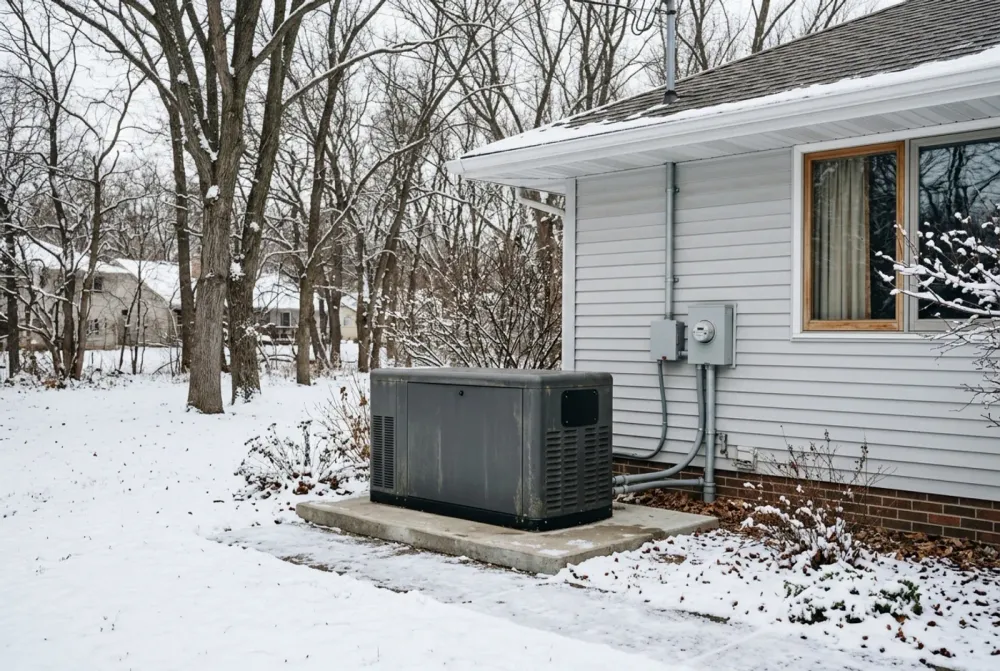
The right generator size is your total running watts, plus your single biggest starting-watt surge, plus a safety margin so the unit never runs flat out. For most Becker-area homes, the well pump sets that biggest surge. Count the well pump and the furnace together, and most families land in the 20 to 26 kW whole-house tier. Still, only a real load calculation tells you your own number.
How do you calculate what size generator you need?
Start by listing everything you want to keep running during an outage. Add up the running watts for all of it. That is your base number.
Next, find the single highest starting-watt surge among your appliances. Motors draw far more power for a second or two when they first kick on than they do while running. This surge, not the running watts, is often what decides the final size.
Add the running watts and the one biggest surge together. Then leave a safety margin on top, so the generator never runs flat out. That total is the size you need.
Generac is one of the most common generator brands. Generac publishes this exact method: add up all your running watts, then add your highest single starting-watt burst. Generac also sorts home loads into two groups. Small "essential" loads, like the fridge and sump pump, go in one group. Bigger "heavy hitter" loads, like a well pump, central air, or an EV charger, go in the other.
Why does a well pump change the math?
A well pump is usually the appliance that sets your biggest starting surge. It is often bigger than homeowners expect.
Published motor nameplate data shows what these pumps really draw. A half-horsepower well pump motor runs at roughly 655 to 960 watts. A three-quarter to one-horsepower motor runs at roughly 925 to 1,600 watts. A one-and-a-half-horsepower motor runs at roughly 1,620 to 2,280 watts. The starting surge on these same motors is much higher. It can run from about 3,700 volt-amps on the smallest pump to more than 15,000 volt-amps on a larger one. The motor pulls its hardest for about one second when it first switches on.
That starting surge, not the pump's day-to-day running watts, is often the single biggest number in the whole calculation. A generic sizing chart based only on square footage misses this. A real load calculation does not.
Call (763) 238-5331 to have Tim run the actual numbers for your well and your panel.
What else is running at the same time during a Minnesota winter outage?
A well pump rarely runs alone. During a Minnesota winter outage, several things draw power at once.
The furnace blower motor typically draws roughly 400 to 900 running watts. It runs for most of the outage to keep the house warm. A block heater adds its own steady draw. A sump pump cycles on and off, especially during a spring thaw, and carries its own starting surge.
None of these alone sets the biggest surge the way a well pump often does. But each one adds to the running total. A load calculation has to count all of them, not just the biggest one.
What size covers most homes in the Becker area?
Most homes in Xpert's service area land in the 20 to 26 kW whole-house tier once the well pump and furnace are both counted. See whether a standby generator is worth it for a Minnesota winter for how that tier compares to a smaller essential-circuits unit, and what a whole-house generator costs by size for current price ranges.
Rural homes on their own well, like many in Clear Lake, need the well pump counted every time. A home on municipal water and sewer may not.
Minnesota electrical permits filed since July 1, 2023 must follow the 2023 National Electrical Code. A generator's transfer switch is its own permitted job. The size you land on is not just an equipment-shopping decision. It is also what gets wired and inspected.
Should you size up if you are not sure?
Oversizing wastes money on equipment and installation you may never use at full power. Undersizing is worse. The generator cannot keep up, and it may shut down or trip a safety breaker right when you need it most.
The safer move is a real load calculation, with a safety margin already built in, rather than guessing up or down on your own.
Get your real number from Xpert Electric
Xpert Electric installs whole-home standby generators across Becker, Monticello, Clear Lake, Big Lake, and the St. Cloud area. Owner Tim has 20 years of experience. He runs the load calculation himself and backs every install with a 1-year parts and labor guarantee.
Call (763) 238-5331 or request a free load calculation.
Talk to Xpert Electric
Questions about your electrician job? We serve Becker and the surrounding area with honest, upfront advice.
Related articles
FAQ
Related questions
Can a generator be too big for your house?
Yes. A bigger generator costs more to buy and more to install, and most homes do not need the largest size available. Oversizing wastes money on equipment you will rarely use at full power.
What happens if a generator is undersized?
An undersized generator cannot keep up with the load. It may shut down or trip a safety breaker when too many things try to run at once, which can happen right when you need it most during a storm.
Do you need to recalculate if you finish a shop or add a well later?
Yes. A new well pump, a finished shop, or an added electric heat source all change your running watts and your biggest starting surge. Xpert Electric can redo the load calculation any time your home's setup changes.
Does Xpert Electric do the sizing calculation for you?
Yes. Tim looks at your panel and the loads you want to keep running, then runs the calculation himself. You get one clear written price before any work starts.